
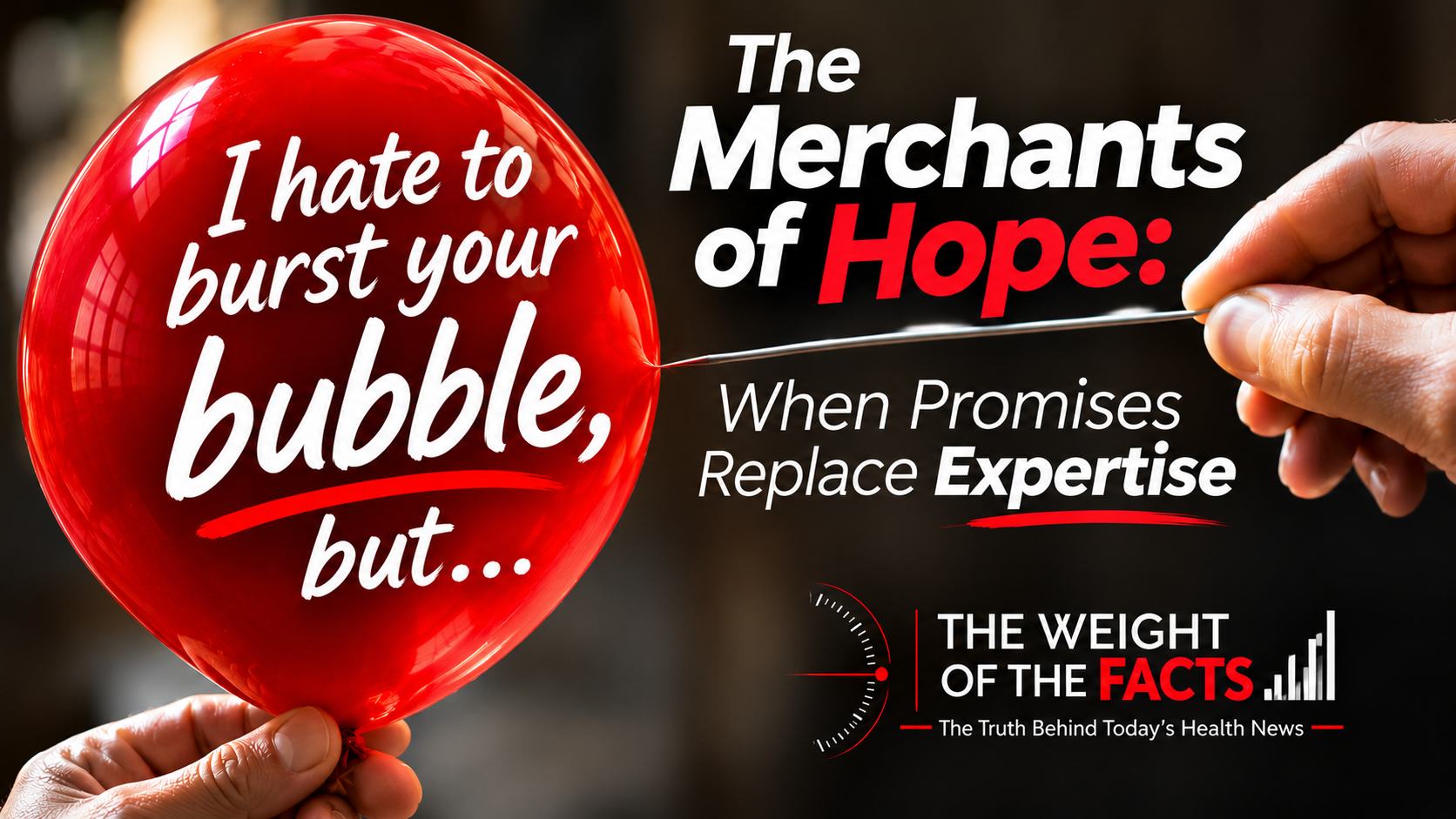
After making so many promises of spectacular transformations, have some forgotten that they are dealing with real human beings?
There is an industry where you can sell happiness, confidence, health, a slimmer body, and even an entirely new life. Sometimes all it takes is a beautiful photograph, a few dramatic testimonials, a convincing pitch, and a promise enticing enough for someone to invest their savings.
We call it coaching, wellness, personal transformation.
And sometimes, that’s exactly what’s being offered.
But other times, I wonder whether we’re really dealing with merchants of hope.
I’m not talking about every coach. I know how valuable sincere, competent, respectful guidance can be. I’m talking about people who promise what they cannot reasonably guarantee, present their opinions as absolute truths, and sell quick fixes to individuals who have already been through so much.
When you work with another human being, you do not get to play with their hope.
THE NUMBERS — Popularity Is Not Proof of Reliability
In 2024, a study published in theInternational Journal of Behavioral Nutrition and Physical Activity examined 676 posts from 47 influential Australian Instagram accounts focused on nutrition.
Of the 510 posts that could be assessed for accuracy, 44.7% contained inaccuracies. Among all 676 posts studied, only 6.1% achieved a quality rating considered good.
Here is another revealing finding: neither follower counts nor account verification predicted the quality or accuracy of the information shared.
In other words, you can be extremely popular without being a reliable source.
These findings do not mean that nearly half of all coaches are incompetent. They do remind us, however, that visibility, charisma, and marketing are not proof of expertise.
Misleading weight-loss claims are nothing new.
In 2002, the U.S. Federal Trade Commission published an investigation of 300 weight-loss product advertisements. Nearly 40% contained at least one claim deemed almost certainly false, while 55% contained at least one claim considered very likely false.
That investigation is more than two decades old. It cannot describe the entire market today, but it documents just how long some businesses have been exploiting people’s desire to lose weight easily.
In Canada, the Competition Bureau states that claims about a product’s performance must be supported by adequate and proper testing. Dramatic before-and-after pictures and testimonials are not a substitute for that evidence.
So I want us to ask an important question.
When did we start confusing an excellent sales strategy with genuine competence in helping people?
THE SCIENCE — A Number on the Scale Never Tells the Whole Story
There’s a question I’ve carried with me for years.
When someone gains weight, why do we devote so much energy to the weight itself and sometimes so little to the factors contributing to that weight gain?
Of course, the mechanisms are complex. Genetics, metabolism, environment, certain medications, sleep, eating habits, and many other factors can all play a role.
But emotions and behaviors may be important, too.
studies6 729
participants−9.0 lb
average weight change analyzed
A 2025 meta-analysis in the Journal of Human Nutrition and Dietetics brought together 47 studies involving 6,729 participants to examine interventions targeting emotional eating.
The researchers observed reductions in emotional eating and, among the 32 studies contributing to the weight analysis, an average weight reduction of approximately 9 pounds (4.09 kilograms).
They highlighted the potential value of techniques involving personal values, setting and reviewing goals, self-regulation, and reflecting on behavior.
This is not proof of a universal formula. Results varied considerably across studies. But they show why it makes sense to pay attention to a person’s relationship with food, emotions, and behavior.
And that aligns deeply with the way I approach coaching.
I don’t just want to understand what someone eats. I want to understand what they’re going through.
What sometimes drives a person to eat when they’re not hungry? What are they trying to soothe? What habits have they developed over the years? How much room do they make for their own needs?
These questions do not mean that every weight challenge is emotional. They mean that we should never reduce a human being to what is on their plate or what the bathroom scale says.
Research also reminds us to be humble about coaching itself.
A systematic review published in 2021, drawing on 38 studies of health coaching for weight loss, concluded that the overall certainty of evidence was very low. The effect seen in controlled studies was minimal, and the analysis of higher-quality studies no longer showed a clear weight-loss advantage.
That conclusion may make people who sell coaching uncomfortable.
To me, it should make us more accountable.
A serious coach should never be afraid to have their methods, results, limitations, and qualifications examined.
Commitment, discipline, behavior change, and ongoing support can all play a role in an effective approach. But no one should present their method as a guarantee of success for everyone.
THE HUMAN SIDE — What the Merchants of Hope Fail to See
Imagine a 52-year-old woman.
For twenty years, she’s been trying to lose weight. She’s followed diets, bought products, spent significant amounts of money, and started over so many times she can no longer remember how often she promised herself this would be the last attempt.
She hasn’t just lost and regained pounds.
At times, she’s lost faith in herself.
One morning, she sees an advertisement. It promises an extraordinary transformation. A revolutionary method. Impressive results. Testimonials that finally make her feel she’s found the answer.
She believes it. She invests. She dares to hope again.
Then, weeks or months later, she realizes she cannot maintain the results she was promised.
And if no one helps her understand what happened, she may tell herself that same painful story yet again: I wasn’t strong enough. I don’t have enough willpower. I can never follow through.
But it isn’t always about willpower.
Sometimes the method wasn’t right for her needs. Sometimes the support wasn’t adequate. Sometimes physical, psychological, or social challenges went largely unnoticed.
This woman is a fictional example, but the feelings her story reflects deserve our attention.
And this is exactly where I draw the line.
We should never make someone believe that simply buying our solution will transform their life.
Not when we know how vulnerable that person may be beneath their smile. Not when we don’t know their story. And certainly not when we cannot acknowledge the limits of our own expertise.
What My Own Journey Taught Me
I once weighed 415 pounds.
I lost 225 pounds without weight-loss surgery or weight-loss medications, and I went through years of change, self-examination, and learning.
But I refuse to use my story as proof that everyone can or should follow the same path.
My experience has given me a deep understanding of certain human struggles. My personal journey, practical experience, and professional skills now inform the way I support others.
Above all, they taught me one thing: no one can do the inner work of personal transformation for another person.
I can listen. I can ask difficult questions. I can share knowledge and tools, help someone build healthier habits, and challenge them respectfully when they drift away from their commitments.
But I cannot sell them a guaranteed outcome. I cannot promise that they will never face setbacks. And I certainly cannot claim that one method will solve every part of their life.
What I can offer is honest, committed, human-centered support within the limits of my expertise.
I believe deeply in personal responsibility. But I refuse to use that principle to blame people when things get difficult.
Taking responsibility for yourself does not mean you have to succeed all on your own.
It means learning to recognize what is within your control, asking for help when needed, understanding your reactions, and gradually taking ownership of the decisions you can influence.
It also means recognizing that some situations call for specialized medical, nutritional, or psychological expertise.
A coach who takes their responsibilities seriously also knows when to refer someone to another qualified professional.
True Leadership Begins With Responsibility
I often talk about human-centered leadership. To me, it’s not a title, a status symbol, or simply the ability to influence others.
Leadership begins in the relationship we have with ourselves.
In our ability to recognize our habits, honor our commitments, make conscious choices, and accept that transformation sometimes takes time.
It requires discipline, yes. But not the kind of discipline that becomes another way to hurt ourselves.
It requires courage, but also compassion. It requires persistence without demanding perfection.
When someone comes to me seeking to lose weight, I don’t just want to help them change the number on their scale. I want to help them better understand the parts of their life they can act upon.
Because when we focus only on the visible outcome, we risk overlooking the habits and challenges that can make that outcome hard to maintain.
But when a person learns to know themselves better, develop independence, and make more conscious choices, something deeper can begin to change.
Not necessarily in a spectacular way. Not overnight. But in a way that truly belongs to them.
I’m Not Here to Sell Miracles
I have nothing against medical advances, qualified professionals, or tools that genuinely help people improve their health.
I simply refuse to call a solution magical when it isn’t.
I refuse to accept that people should spend their savings on promises that go beyond the available evidence.
And I refuse to see someone treated as a commercial failure when the advertised results don’t materialize.
What I want to set me apart isn’t the size of my promises. It’s the quality of my commitment to the person in front of me.
I’d rather tell someone that the journey will require real work than sell them an easy road that may not exist.
I’d rather ask an uncomfortable question than simply tell them what they want to hear.
I’d rather build trust and independence than make someone dependent on my coaching.
Because my goal is not for anyone to need me forever.
My goal is for them to gradually discover that they have the power to make different choices for themselves.
If I could leave just one thought with anyone looking for a coach, program, or method to transform their life, it would be this:
Before asking someone how much they can help you lose, ask what they can help you understand, learn, and build.
A beautiful promise can create hope. But only an honest, appropriate, sustained approach can give that hope a chance to become something real.
Don’t entrust your hope to someone who promises you everything. Look for someone who can support you with competence, respect, and integrity.
And to those of us who have chosen to guide other human beings, I want to say this:
We are responsible not only for the results we promise, but also for the trust people place in our hands.
Perhaps that’s where true human-centered leadership begins.
Dare to become the person you dream of meeting.
Scientific and Documentary Sources
- Denniss et al. (2024). Study of the accuracy and quality of nutrition information posted by influential Australian Instagram accounts. PubMed.
- Federal Trade Commission (2002). Report on weight-loss advertising. FTC.
- Competition Bureau Canada. Guidelines on performance claims and adequate, proper testing. Official guidance.
- Systematic review and meta-analysis (2025) on emotional eating interventions. PubMed.
- Systematic review and meta-analysis (2021) on health coaching for weight loss. PubMed.
Leave a Reply