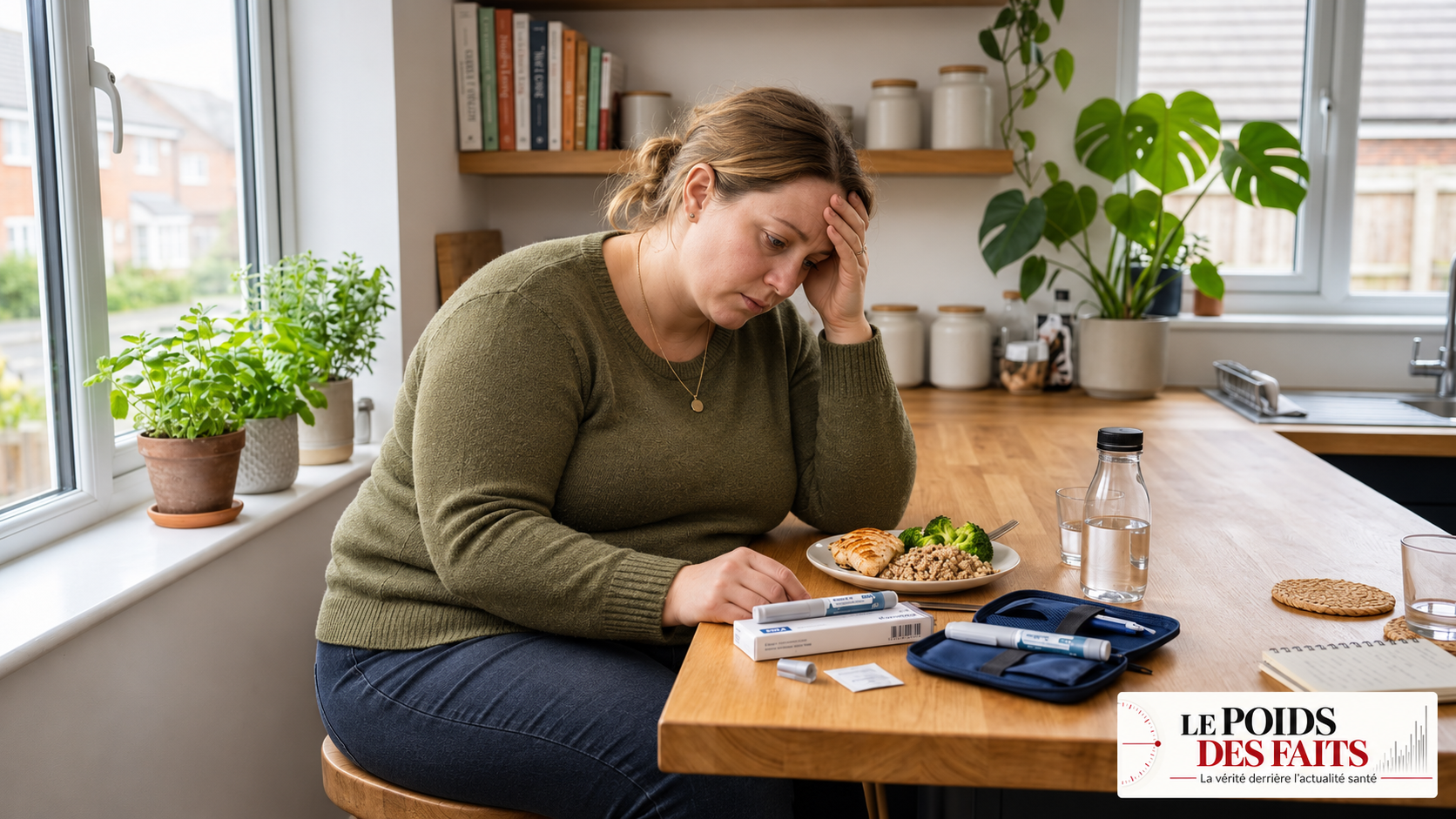
Millions of people are hoping to regain their health through these treatments. But behind the pounds lost, what is happening inside the body? And above all, what happens to the results when treatment stops?
Today, all you have to do is open social media to see spectacular physical transformations. Women and men say they lost 30, 50, sometimes even 100 pounds thanks to medications like Ozempic, Wegovy or Mounjaro. For people who have struggled with their weight for years, these treatments represent enormous hope. And that hope is legitimate.
But behind these results, some questions deserve our attention. What are the benefits, the side effects and the long-term consequences? And above all, does losing weight necessarily mean we’ve understood what led us to gain it? Let’s look at the numbers, the science and, above all, the human being.
THE NUMBERS: Impressive results, but what exactly are we losing?
In the SURMOUNT-5 clinical trial, published in 2025, participants treated with tirzepatide, the molecule in Mounjaro, lost an average of 20.2% of their starting weight after 72 weeks. Those receiving semaglutide, found in Ozempic and Wegovy, lost 13,7 %. For a person weighing 250 pounds, that works out to about 50 and 34 pounds respectively. These are remarkable results.
However, a body composition analysis from SURMOUNT-1 shows that about a quarter of the weight lost on tirzepatide was lean mass. Lean mass isn’t just muscle: it also includes water and other tissues. But this finding is a reminder of how important it is to preserve our strength, our mobility and our independence, especially as we age.
What happens when you stop? A systematic review published in The BMJ in January 2026, covering 37 studies and 9,341 participants, found that weight regain was common after stopping weight-loss medications. For newer treatments like semaglutide and tirzepatide, it estimated an average regain of about 0.8 kilogram (about 1.8 pounds) per month. That’s an average, not an individual destiny. But it forces us to talk about maintaining results from the very start of the journey.
THE SCIENCE: The benefits are real. So are the risks.
Ozempic and Wegovy contain semaglutide, which acts on the receptors for the hormone GLP-1. Mounjaro contains tirzepatide, which acts on both GLP-1 and GIP receptors. These mechanisms influence hunger, fullness and blood sugar. So these medications aren’t simple appetite suppressants, and their benefits aren’t always limited to weight.
In the SELECT trial, conducted in more than 17,000 adults with established cardiovascular disease and overweight or obesity, but without diabetes, semaglutide reduced the relative risk of major cardiovascular events by 20%. That’s an important medical result, and it would be unfair to ignore it.
But side effects need to be laid out just as clearly. Nausea, vomiting, diarrhea, constipation and abdominal pain are well documented. Less common, sometimes serious complications are also the subject of warnings: gallstones and gallbladder inflammation, acute pancreatitis and kidney injury, which can occur in particular with severe dehydration. In the Wegovy trials, gallstones were reported in 1.6% of people treated, compared with 0.7% on placebo.
Not everyone experiences these complications. Many people get major benefits from their treatment. However, we still have limited data on use over several decades. Preserving muscle function, eating enough and setting up serious medical and nutritional follow-up should all be part of the conversation. These treatments can help manage a chronic disease; they don’t replace every dimension of a healthy life.
THE HUMAN SIDE: Behind every pound lost, a story no one sees
Picture a woman who, for twenty years, has been promising herself that this time will be the one. She has tried diets, counted calories, started over dozens of times. She probably knows better than anyone what she should be eating. Yet every time she gains the weight back, something breaks a little more inside her. She looks in the mirror with disappointment, sometimes avoids family photos and chooses clothes that help her hide rather than feel beautiful. After starting over so many times, she ends up doubting not only her ability to change, but also her own worth.
And then there are those evenings when food becomes much more than a meal. After a day of taking care of others, meeting expectations and holding back her emotions, she finds herself alone in front of the fridge. She isn’t necessarily hungry. She’s tired, anxious or simply running on empty. For a few minutes, eating brings her comfort. But when that moment passes, the guilt comes back. She promises herself she’ll do better tomorrow, without always understanding why she keeps repeating a behavior that makes her suffer.
Of course, not everyone living with obesity lives this reality. The causes of weight gain are many, including biological, genetic, environmental and social factors. But for those who sometimes use food to soothe their emotions, that pain deserves to be heard.
One day, this woman discovers a medication that might finally help her. She starts treatment, her appetite drops and the pounds gradually disappear. Her clothes get too big, the compliments start coming. Maybe she finally dares to put on that dress she loved so much. For the first time in a long time, she looks in the mirror with a bit of hope. And no one should take that joy away from her.
But while her body is changing, has she also learned to recognize what drives her to seek refuge in food? Has she found other ways to welcome her sadness, her stress or her loneliness? Maybe so. Maybe not. Weight loss alone doesn’t tell us what has changed on the inside.
That’s why I say: “Losing weight is not the same as healing.” Not because losing weight can’t significantly improve health, but because we can transform our appearance without transforming our relationship with ourselves. A person can lose 60 pounds and still feel like they’re not enough. They can receive a thousand compliments and still be unable to give themselves a single one.
And that brings me to an essential question: why do we want to lose weight? Sometimes for our appearance. But very often, also for our health: to get our energy back, walk without getting out of breath, play with our grandkids, stay independent and live life to the fullest. So when someone takes this kind of medication to lose weight, are they really moving toward health? On several medical fronts, for some people, the answer is yes. But our health also includes our strength, our quality of life, our emotional balance and our ability to take care of ourselves every day.
And what if treatment stops and the weight comes back? I think of the person who had finally regained confidence in herself, of the fear of seeing her old body again, and of that inner voice that might whisper that she’s failed once more. Yet weight regain can also come from powerful biological mechanisms. It isn’t proof of a lack of willpower. It’s precisely in those moments that support and understanding become essential.
I deeply believe in perseverance, discipline and commitment to yourself. Not a discipline that punishes us because we don’t love our bodies, but one that comes from a sincere desire to take care of them. A perseverance that lets us start over without condemning ourselves. And a self-love that depends neither on our appearance nor on the number on the scale.
The most beautiful transformation may not be the one others notice in a before-and-after photo. It’s the one that happens quietly when a person stops fighting against themselves and finally starts becoming their own ally.
CONCLUSION: Losing weight, or taking back control of your health?
These medications represent an important medical advance. They offer real possibilities, but they also come with risks and limits that deserve to be explained. This isn’t about glorifying them or condemning them: it’s about giving them their rightful place within an overall approach to health, with support tailored to each person.
Discipline isn’t about being hard on yourself. It’s choosing to take care of yourself, even when it’s difficult. Perseverance isn’t about never falling. It’s learning to get back up without hating yourself. And self-love means understanding that we deserve to take care of our health long before we reach the weight we’re hoping for.
We shouldn’t have to lose weight to learn to love ourselves. Maybe it’s precisely by learning to love ourselves that we find the strength to take care of ourselves for the rest of our lives.
About Jacques Aubin
Author of the book For Once, Go All the Way!, communicator and coach, Jacques Aubin supports people who want to take back control of their health, their habits and their lives. Through his talks, seminars, training programs and individual or group coaching programs, he shares an approach grounded in experience, awareness, responsibility and respect for the human being.
Scientific sources
SURMOUNT-5 (2025), comparison of tirzepatide and semaglutide; SURMOUNT-1 (2025), body composition analysis; The BMJ (2026), systematic review of weight regain after stopping treatment; SELECT (2023), cardiovascular benefits of semaglutide; Health Canada, product monographs for Wegovy, Ozempic and Mounjaro.
Leave a Reply