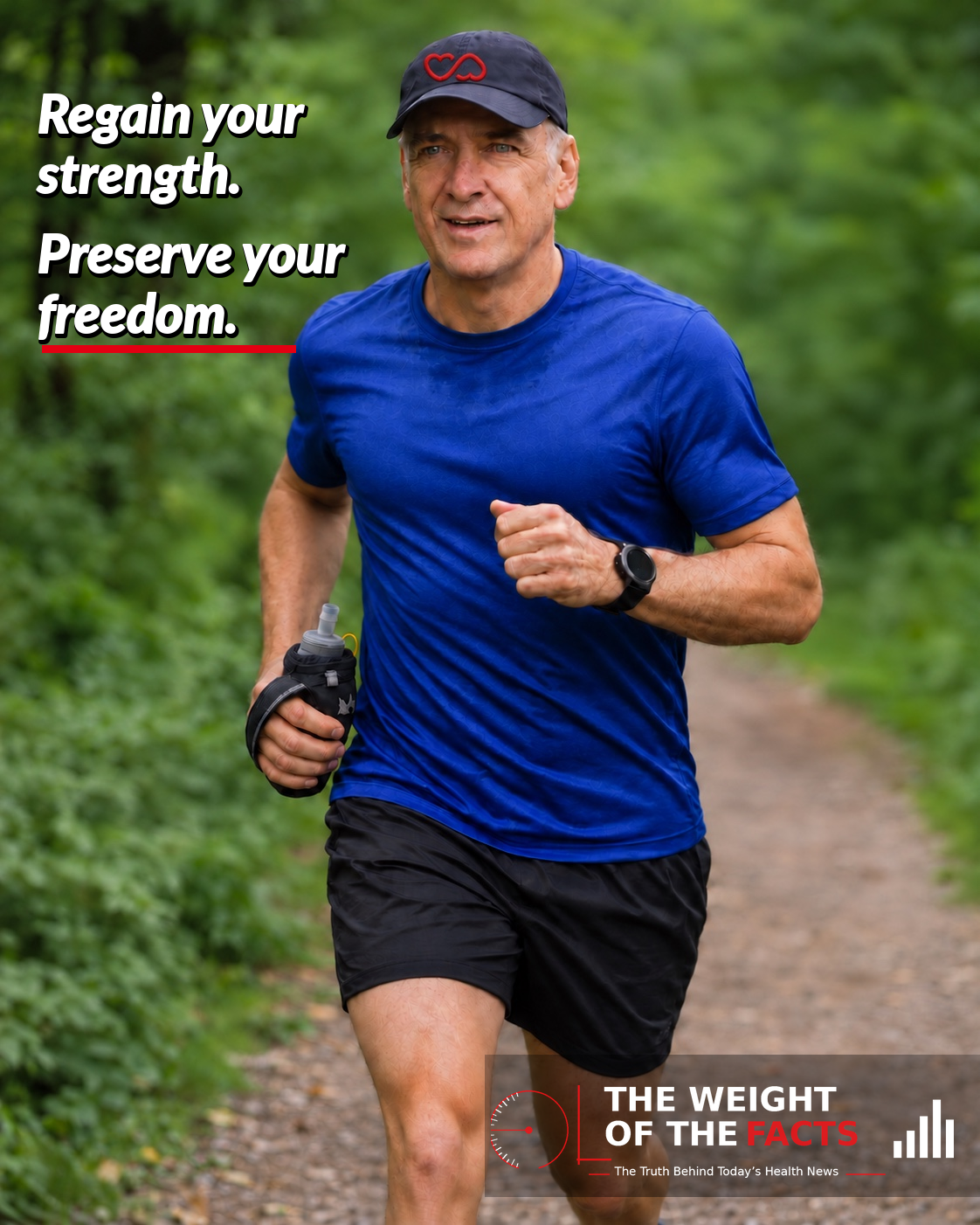
What if getting older didn’t necessarily mean getting weaker?
Good morning, enjoy your coffee, and happy reading! ☕
Some things are repeated so often that they eventually start to sound like unquestionable truths.
“At my age, it’s normal to feel tired.”
“I don’t have the strength I used to.”
“I’m too old to start exercising.”
And my personal favourite: “At my age, maybe I should slow down a little!”
Slow down? Absolutely, when our bodies need rest. But does that mean we have to give up on becoming stronger?
Between you and me, sometimes we give the number on our birth certificate far too much power! 😄
Of course our bodies change as we age. It would be foolish to pretend otherwise. But does that mean we have to accept a gradual loss of strength, balance and independence without doing anything about it?
Recent scientific research offers an encouraging perspective.
And this morning, I want to talk about something that goes far beyond muscle: our ability to keep enjoying life to the fullest.
THE NUMBERS — 905 people, 17 studies, and encouraging news
On November 17, 2026, a scientific review published in Nutrients explored an important question: what happens when older adults experiencing significant muscle weakness combine resistance training with nutritional supplementation?
The researchers analyzed 17 clinical trials involving 905 participants aged 60 and over.
These participants had a condition known as sarcopenia, which is characterized in part by reduced muscle strength and impaired muscle function.
Across the studies reviewed, combining resistance training with nutritional supplementation was associated with an average improvement in handgrip strength.
In an analysis combining 13 trials, the average improvement was approximately 1.97 kilograms of grip force compared with the comparison groups.
When the researchers looked separately at studies that provided daily supplementation, the estimated improvement reached approximately 2.50 kilograms.
By contrast, results were less conclusive when supplements were taken only after exercise.
The researchers also found no clear improvement in walking speed, and the certainty of the evidence differed depending on the outcome examined.
In other words, the findings are encouraging, but they are not a miracle formula.
And that’s a good thing. Our health deserves better than spectacular promises.
THE SCIENCE — Our muscles don’t retire at 60!
As we grow older, we may gradually lose muscle mass, strength and certain physical abilities.
That is a real phenomenon, but its progression varies considerably from one person to another.
Our lifestyle, health conditions, nutrition and activity levels all play a role.
What interests me most about this research is the reminder that several aspects of health deserve our attention at the same time.
On one side, there is strength training.
This means making our muscles work against resistance. We can do it with weights, resistance bands, exercise machines or simply our own body weight.
On the other side, there is nutrition.
To maintain and rebuild tissues, our bodies need enough food and appropriate nutrients, including protein.
Some nutritional interventions may be useful, particularly when someone is not getting enough nutrients through food. But this research does not mean everyone should buy supplements or that supplements can replace balanced meals.
It is also important to remember that the research specifically involved people living with sarcopenia. Its results cannot automatically be applied to every adult over 60.
Another distinction matters.
Strength is not measured only by the size of our arms or how much weight we can lift.
We see it in ordinary daily activities: getting out of a chair, climbing stairs, carrying groceries, walking confidently and keeping our balance.
All these abilities contribute to our independence.
International public-health guidelines encourage older adults to include regular muscle-strengthening activity in their lives, while adapting it to their abilities and health.
Our bodies need movement. And sometimes they also need us to begin trusting them again.
THE HUMAN SIDE — Growing older does not mean giving up
There is an important difference between accepting our age and giving up on what might still be possible.
Accepting our age means acknowledging that our bodies change, respecting our limits, allowing time for recovery and honouring our personal history.
Giving up sometimes means believing nothing can improve simply because we have celebrated another birthday.
As for me, I refuse to see age as a sentence.
I know what it means to change my habits and rebuild my relationship with my body. I also know how much it can take to learn to trust our physical abilities again.
And I’ve learned that lasting transformation rarely begins with a spectacular achievement. More often, it begins with a simple decision: not to resign ourselves to the way things are.
Now, I’m not saying everyone should become an athlete at 65. We don’t all have the same health, the same abilities or the same goals.
And thank goodness for that! Imagine if everyone decided tomorrow morning to become a bodybuilding champion. The gyms would be packed, and pharmacies would probably run out of muscle-rub cream! 😄
Seriously, though, I believe we need to change the way we talk about ageing.
Instead of asking only how many years we have left, perhaps we should also ask: How do we want to live the years ahead?
Do we want to travel? Walk through nature? Play with our grandchildren? Go about our daily activities as independently as possible? Or simply continue feeling comfortable in our own bodies?
Muscle strength then becomes much more than a matter of appearance. It becomes a way of preserving a degree of freedom.
And that freedom deserves our attention.
PRACTICAL STEPS — Five ways to start again, at your own pace
The good news is that you do not need an expensive gym membership to get started. What matters is finding activities that suit your condition and making gradual progress.
1. Start where you are. If you haven’t been active for a long time, there is no need to make up for ten years of inactivity in a single day. Gentle, appropriate, consistent movement is already a meaningful starting point.
2. Make room for strength training. Depending on your abilities, simple exercises might include standing up from a chair, using a resistance band or lifting light weights. Public-health guidelines generally recommend muscle-strengthening activities at least twice a week for older adults, with individual adaptations when needed.
3. Feed your muscles. A varied diet that provides enough energy and protein helps support muscle health. Eggs, fish, dairy products, legumes and many other foods can contribute. Supplements are not automatically necessary; whether they are useful depends on individual needs.
4. Remember balance and recovery. Strength matters, but it isn’t everything. Balance, mobility, sleep and recovery also deserve a place in our routines.
5. Measure progress differently. Rather than comparing yourself to who you were at 30, notice what you can improve today. Is it getting easier to stand up? Do you walk more confidently? Are everyday activities becoming more comfortable?
Sometimes our most valuable progress is not what we see in the mirror. It is what we experience in everyday life.
If you live with cardiovascular disease, balance problems, significant frailty or a physical limitation, ask a qualified healthcare professional to help determine which activities are appropriate before beginning a new exercise programme. Safe progress matters.
ONE LAST THOUGHT — We cannot stop time, but we can choose what we do with the time we have
I don’t believe in promises of eternal youth. And I don’t think we should spend our lives fighting our age.
I much prefer the idea of growing older while preserving our curiosity, dignity, capacity to love and, as much as possible, independence.
There will always be difficult days. Limits we need to respect. Moments when we have to slow down.
But slowing down does not necessarily mean giving up.
At 40, 50, 60, 70 or beyond, opportunities to improve our physical condition may still exist, depending on our health.
And if you believe it is too late to begin, I would like to leave you with one question:
What if it isn’t your age that is holding you back, but what you believe is still possible for you?
You do not need to be 25 again. You simply deserve to care for the person you are today.
One step at a time. One day at a time. And perhaps, for once, all the way!
Dare to become the person you dream of meeting.
SCIENTIFIC SOURCES
1. Yin, Y., et al. (November 17, 2026). Resistance Training Combined with Nutritional Supplementation in Older Adults with Sarcopenia: A Systematic Review and Meta-Analysis of Post-Exercise and Daily Supplementation Schedules. Nutrients, 18(22), 3826. Read the study.
2. Centers for Disease Control and Prevention. Older Adult Activity: An Overview. Read the guidelines.
3. World Health Organization. WHO Guidelines on Physical Activity and Sedentary Behaviour. Read the guidelines.
About Jacques Aubin
Author of Pour une fois, va jusqu’au bout! (For Once, Go All the Way!), speaker and coach Jacques Aubin supports people who want to take greater ownership of their health, habits and lives.
Through his talks, seminars, training programmes and individual or group coaching, he shares an approach rooted in lived experience, awareness, personal responsibility and respect for every human being.